Category: Uncategorized

  • Root-Bound Stories

    close-up photo of a root-bound plant resting on a pink pot.
    Root-bound and ready to plant!

    Fictional worlds take time and energy to build, and for some (like me) creating in this manner fuels the fire within. In no time at all, ten thousand years of history exists on the screen, and the protag’s genealogy is mapped eight generations back. The magic system has internal logic that would survive peer review. Individual cultures have their own cuisine, their own lunar rites, their own slang. A new calendar system is in place, certain regions produce certain crops, and specific families have specific abilities, but there are always wildcards (true story).

    Readers all say the worldbuilding is impressive.

    They also say they’re having trouble getting into the world. Or worse, they get into the world just fine and still don’t care what happens to the people in it. This is an often-encountered situation, one I can draw a direct parallel with in horticulture: the condition of a plant being root-bound.

    What “Root-Bound” Means

    When a plant stays too long in a container, or when it’s never transplanted at all, the roots run out of room to expand outward. So they circle. They layer. They grow back into and over themselves, filling every available inch of the pot with root mass so dense there’s barely any soil left.

    From the outside, the plant may look fine. It leafs out, takes up water, it survives. But it doesn’t thrive. Growth is stunted and yellowish. Flowering is sparse or doesn’t happen at all. In an effort to find more nutrients, the plant pours energy into its root system, which becomes an increasingly elaborate underground architecture, while the visible structure above the soil stays thin.

    The roots aren’t the problem, though. Roots are necessary. A plant with no root system dies immediately. The problem is ratio: when roots fill every inch of the container, there’s no growing medium left to hold water and nutrients. At a glance, the plant can still look fine, the way a great blurb, a phenomenal cover, intriguing About copy can look fine. Underneath, it’s suffocating on its own overgrowth.

    A root-bound story works the same way. The worldbuilding is extraordinary—years of work, sometimes, building the history, geography, culture, magic, economics, and religion the story will root in. The architecture is vast, detailed, internally consistent. And then the story itself struggles to grow.

    This is root-bound.

    How to Recognize It

    The signals show up in feedback first, usually. Impressive is the word that should give you pause—impressive worldbuilding, impressive detail, impressive scope. Impressive, by nature of the word, is admiring something from a slight distance, though. It’s not the same as immersed, or invested, or I couldn’t put it down.

    Readers may say the worldbuilding is overwhelming. Not that it’s too much worldbuilding in an abstract sense, but too much arriving before they have a reason to care about it. The information is present; the hook for why it matters and why the reader should care isn’t.

    Characters can feel thin despite their elaborate setting. This one feels counterintuitive because the writer has often done significant character work, detailed their backstory, and provided clear motivation. But the characters are competing for page space with the world itself, and in a root-bound manuscript, the world is winning. Readers spend so much cognitive energy processing setting, history, and systems that character has to work harder than it should to register.

    Plot is episodic. The story moves from location to location, culture to culture, set piece to set piece—each one an opportunity to reveal more of the world. But the throughline is the world itself, not the character’s want or need or transformation. Readers follow the tour. They don’t feel the pull.

    The first fifty pages are heavy. This is where root-bound manuscripts are most tangible. The writer knows that readers need context to understand what’s happening, so they provide it— upfront, thoroughly, before the story has generated enough momentum to carry the weight. By the time the actual story begins, some readers have already let go.

    And there’s a subtler signal, one the writer might recognize in themselves before any reader names it: the scenes that feel most alive to write are the ones that reveal the world. The magic system clicking into place. The cultural detail unfolding. The history surfacing through dialogue in an old library. Writing the character moments feels harder, less satisfying, more like obligation. That preference is useful information for diagnosis.

    Not the Same as World-as-Character

    There is an important distinction to make about certain world-centered stories, however.

    Some stories have the world functioning as a character in its own right. Gothic fiction, cozy fantasy, and plenty of science fiction novels, to name but a few, are built that way on purpose—an academy house with its own rules, a village whose seasons shape the plot as much as any person does, a ship or station whose systems create real stakes—those aren’t root-bound. Those worlds are doing narrative work the story assigned to them, and the human characters are written to share the stage rather than dominate.

    Root-bound is different. It’s not the world claiming a character’s role. It’s the world crowding out the space where a character role needs to exist and yet doesn’t.

    Why This Happens

    Often the story idea itself is the size of a shelf of books, and the writer tries to grow it in the space allotted for a few volumes.

    This isn’t a failure of discipline or that the writer refuses to hold anything back. Many root-bound writers have already cut, trimmed, and simplified considerably from what originally lived in their heads. The world may genuinely have enough material to sustain something much longer than this: enough history, enough incident, enough scope for a trilogy or more. But the story living on top of that world—this cast, this plot—doesn’t have equivalent depth. The plot and character development runs thin at half the length, so the page count fills with world instead. The writer isn’t hiding the story; there isn’t enough story yet to hide. The world was conceived as an ecosystem. The story was conceived as a single season within it, and the season isn’t long enough to need everything the ecosystem contains.

    **Sidenote: I’ll admit this one hits close to home. I’m sitting on a fantasy world I can see completely, clearly big enough to outlast the story I’ve actually got, so I’m stalled. See, it even happens to editors when they can name the problem. Advice, anyone?…

    What Root-Bound Is Not

    It is not a story where the writer needs to reveal less, though that is an actual issue and a different one, with its own conversation. Root-bound is not about a writer who built the right-sized world and mishandled the reveal.

    Root-bound is a writer who built a world sized for something larger than the story currently in front of them and hasn’t yet decided which direction to resolve that mismatch: grow the container or right-size the contents.

    Growing the container might mean the standalone becomes a duology. It might mean the novel was always a series pretending to be one book. Right-sizing the contents might mean the eight-generation genealogy is real and rich and simply doesn’t belong to this story. It belongs to the next one, or the one after that, or a page in the world bible the reader never needs to see.

    Neither direction is a failure. Both are decisions the writer must consider. What doesn’t work is refusing to make either one, trying to keep the full-scale world and the single book container at the same time. The mismatch lives in the fundamental agreement between what the world requires and what the story promised to deliver, not in any sentence-level revisions.

    What Root-Bound Feels Like From the Inside

    If you’re writing a root-bound story, you probably already know something is off. The feedback has been consistent enough to stop feeling like reader error. Revisions to-date haven’t fixed it. You’ve tightened the prose, trimmed the exposition, added a faster opening… and the fundamental problem persists.

    That persistence is the tell.

    Here’s what makes root-bound manuscripts hard to diagnose from the inside: the world is real; it’s unique and excellent, and admitting it might be the problem feels like admitting years of work were wrong. They weren’t. But that fear is exactly why so much root-bound revision stays at the sentence-level—tightening prose is safe. Questioning whether the world itself needs to shrink, or the story needs to grow to meet it, means being willing to treat your own favorite thing as a variable instead of a fixed point. That’s a harder kind of objectivity than craft skill alone provides.

    The roots are still there. The canopy is still in place. Only real objectivity about the current ratio, not more polish, can show what actually needs to shift.


    Root-bound manuscripts need a different kind of revision than most writers expect—not line-level, and not structural in the conventional sense, but ecological. A Story Ecosystem Assessment™ maps the current balance of elements in your manuscript to identify where energy is stalling and what the visible story needs to grow. If your worldbuilding is impressive and your story still isn’t connecting, that’s worth looking at closely.


    Aime Sund is The Narrative Gardener—a fiction editor and horticulturist at Red Leaf Word Services, where she helps genre fiction authors grow stronger stories through her Narrative Ecology™ framework.

  • Happy Earth Day!

    Huphaeans would honor Pater Below today by burning brown candles, as they do every third-quarter phase of Soror Moon.

    How will you honor Pater Below today?

  • Reblog — Hopes and Fears and Fiction — Writer Unboxed

    This landed in my inbox this morning, the day after I wrote a piece about fear. Fear has been on my mind a lot lately and I am in a constant struggle with it in several areas of my life.

    In this piece, Donald Maass reminds writers of some questions that should be asked while writing, and then asked again by editors as they make suggestions.

    Reading it reminded me of why I read certain things at certain times. Maybe it will resonate with you, too.

    And I also just remembered I need to buy his book, The Emotional Craft of Fiction, I’ve been meaning to for a while. Happy Birthday to me! 🎂

    What do you need to be reminded of today?

    What are your hopes and dreams?  What are you most afraid of? Search online for common fears and phobias, and you will quickly find that whatever terrifies you also terrifies others.  Do you, for instance, suffer (as so many do) from Koumpounophobia, Alektorophobia, Sidonglobophobia, or Hippotomonstrosequippedaliophobia?  Those are the paralyzing fears of buttons, chickens, cotton…

    Hopes and Fears and Fiction — Writer Unboxed
  • Nyssa’s Nuggets

    “When quiet moments come, take advantage of them.”

    A quiet moment to herself…

    With two rambunctious puppies in the house, Nyssa’s quiet moments are significantly less these days. I caught this one the other day as she rested in the newly refinished “Canine Cabin.” I am currently on the lookout for discarded armchairs or a loveseat to finish off the decor. 😄

    Nyssa does love her “outside bed,” as I call it, especially at this time of the year. It also gives her a place to retreat to when she’s had enough of the young ‘uns and needs a break. They know not to bother her when she is on her bed, she is unanimous in that rule.

    Many times I envy her the ability to just unplug and check out for a while. As a driven soul, I find it almost impossible to do that. Most everything I do has a purpose and now with a business to run, I am making everything possible count double.

    Even when I’m taking a self-care detox bath I’m still reading a writing craft book, listening to a podcast, reading a pleasure book (which will count towards my GoodReads tally), or doing some business-related social media posts. 🙄

    It is that difficult for me to not continually push forward, even the smallest bit.

    I know I’m not alone in this, many of us entrepreneurs and business owners are wired the same way. It’s how we actually make things happen.

    This is something I have always known about myself and even taken pride in. This year, though, I’m attempting to have more moments like Nyssa—when I do relish the silence and recharge from it.

    Running a business solo and editing alike take massive amounts of energy and focus. That drains a body and a brain faster than athletic pursuits, I think. We all know we benefit from some down time. Our business and clients will also, in turn.

    So in a bold move (for me), I’m giving myself permission to take a page from Nyssa’s book and take advantage of some quieter moments. In the few experiments I’ve done so far, I’ve been more productive in the hour after the quiet time than I would have been had I trudged on. That’s a positive, I’d say.

    Nyssa is right about most other things, why not this?

    The wisdom of an Akita at its best. Quiet moments are for rest.

    Do you allow yourself some quiet moments, some unplug time? How do you take them? Let’s share some below in the comments and play the #writer’slift #editor’slift game. Have a great week! Woof woof roooooo! 🐕‍🦺


    Want to know more about Quill & Orb Press editing? Head over to my website!

    You can get there by clicking here!

    Quill & Orb Press editing offers the elements of a collaborative mindset, respect for the writer, and an editor’s eye and ear, combining them to cultivate your ideas and drafts into books that enchant and delight. It is alchemy at its finest🔮✨✏📚!

    Keep up with what’s new at the Quill & Orb Press through the monthly newsletter! You can subscribe here. Nyssa occasionally adds more Nuggets too, when she’s not too busy 😉.

    ©2021 Quill & Orb Press. All Rights Reserved.

  • I’ve Been MIA… apologies!

    As you may have seen in the last Nyssa’s Nuggets, I added Cedar, an Australian Shepherd puppy to my pack.

    Since then, Wicket, a Bernaussie puppy, has arrived. Wicket is 3.5 weeks younger than Cedar, and a complete love. He got the Bernese personality and coloring, but with a natural bobtail that gives him a perfect Ewok bum—hence the name, Wicket.

    Wicket
    Is that not the cutest fuzzy bum?

    There isn’t much height difference between the two of them now, but Cedar is ten pounds heavier than Wicket. Cedar is a beast, built like a fire hydrant—all muscle and bone. He is also as fiery as his coat and his Leo birthday… He is and will be a handful, for sure.

    Cedar, 3.5 mos

    Needless to say, things have gone a bit wonky here as far as any schedule goes. Eleanorah hasn’t left for less chaotic locales, yet, in fact she has been honing some writing skills and has managed to get another random scene on the page.

    She apologizes for the absence in the story and is eager to get back to it, pronto! Thank you for your patience, here’s hoping all is well with all of you at this whirlwind time of year even if we weren’t dealing with a resurging pandemic.

    Happy Thanksgiving to all of my fellow Americans. Be on the lookout for an episode from Huphaea very soon! I’m sure you will be able to follow the puppies’ growth with Nyssa’s Nuggets, she will be an integral tutor in their education.

    this is when I can get some work done!

    Talk to you soon! Elements be!~

  • A Writing Group Piece — The Silence of the First Snow

    I belong to a local writing group here in town. This is my second session with this set of ladies for Tuesday morning Zoom meetings. I wasn’t sure how I would do with it when I began, but knowing my desire is to have people read my novel, it seemed a logical place to start. Some months later, I really enjoy myself and am often surprised at the composition I come up with. I thought I would share this one with you just for the sake of sharing. Let me know what you think of it.~


    It snowed on Friday. I’d say about five inches fell here, since it went on longer than it was forecast to. Did that surprise me? Not really, considering two days earlier it rained all day and it was supposed to be the best day of the week. But we are New Englanders, we take what comes and commence bitching about the weatherpeople like champs. Oh well.

    Nyssa enthralled with the snow

    The snow didn’t bother me, as it appeared to for many of my close comrades. My dog Nyssa waits six months for that cold, white stuff to fall and she is in her glory, stretching out her full length to get as much of it on her as possible. She spends hours outside in it, just laying there, or chasing Dash around, then she comes inside with a crusty snow blanket on. It’s hard not to smile and laugh at her simple delight in something totally natural.

    After the snow stopped falling, I took Nyssa for her afternoon walk. The sky was crystal clear blue then, the sun was out, and the world around me had that muffled feeling of being coated with a thick blanket. I took a picture of Nyssa trotting ahead of me down the path toward the woods, trees laden with a pristine frosting of white, and posted it on social media with the caption “The muffled silence of early snow is deafening.” In that moment, it truly was, and that was the very first thing that popped into my mind.

    heading into the silence

    I thought about it for the duration of our walk. What is it about that first snowfall that is so unique? This one happened to come when many leaves are still on the trees, so the smaller saplings groaned under the unwelcome weight, bending down to ask the earth for more support, it seemed. It closed in the canopy above us, making the forest into a tent instead of an amphitheater. An air of suspense hung all around as the arched saplings threatened to dump their cargo down my back if I should disturb them and set them free.  

    We padded on along the snowed-in path, Nyssa’s feet making no noise, while mine churned out that grunting sound that compressed snow makes. No birds sang, no melting clumps plopped into the sea of white below, nothing moved or sounded except us. It was mesmerizing.

    It may be an oxymoron to say the silence is deafening, or even that silence has a sound, but both are true. The air on that new snowy afternoon had a presence that only happens in that situation. It took up all of the space that was allowed by the drooping branches, fountains of encased leaves, and the space in my jacket hood. My ears felt attuned, on edge even, straining to hear something, anything, but there wasn’t any discernable sound there. And that was a sound in itself. It made me aware of everything I would normally hear on this walk for all of its absence.

    Then I also thought, what of the other senses could this happen with? Not smell, or taste. Those are pretty absolute. Sight? I would argue yes, that’s what we as writers try to do, create something with words that isn’t seen with the eyes so much. And perhaps even touch, as it is possible to feel something that is not, or feel something in its absence.

    Nyssa and I finished our walk and the awe still held. Perhaps I was dreaming and we were walking in some New England-wide snow globe on an alien’s shelf that they shook up for the first time in months just for giggles. Either way, the new snow silence held my attention for that stretch of hours last Friday, and it is something I look forward to after snowstorms. Wrapped in a thick white muffler, the land holds its breath and the sound of the silence is truly deafening.~


    Have you ever heard that kind of silence? Are there other experiences that give you that kind of feeling? Comment below and let me know, I’d love to know.

  • Reblog — 5 Ways Paragraphing Supports Story — Writer Unboxed

    After doing a challenging line editing assignment all weekend, I found this post on paragraphs to be a welcome refresher authors occasionally need.~

    photo adapted / Horia Varlan If the last time you thought about paragraphing was when you learned that a paragraph was comprised of a topic sentence, three supporting sentences, and a conclusion, listen up: that staid structure will not have the power to draw readers into your story. 1,940 more words

    5 Ways Paragraphing Supports Story — Writer Unboxed
  • Reblog — Ground Your Characters with All Five Senses — Writer Unboxed

    Writers are cognizant of how important it is to include all of the senses in the narrative. This article explores how important inclusion is, for the author and the words.~

    When I’m writing—these articles, for example—I often compose a kind of first draft in my head, and I usually do it when I’m out on a long walk with the dog. For this article, I knew I wanted to get across the idea that writers can introduce elements from one or all of the five…

    Ground Your Characters with All Five Senses — Writer Unboxed
  • The Great Collection of the Elemental Families of Huphaea, anid 1830  #12

    The Great Collection of the Elemental Families of Huphaea, anid 1830 #12

    Hello Everyone! There’s a cool breeze wafting in my window as I type, it feels sort of like—I can’t say it—fall? Yikes! It won’t be long now until I put the pool away, but while the sun is still warm, I’ll be out in my hammock. I hope all is well with you in your corner of the world, and let’s get on with the exploring, shall we?

    When we left Elahna, she had just returned from her trip to the top of Rosewood Manor. Let’s see what other mischief she gets herself into.~


    back in my rooms…

    I stopped back in my room, since Rosewood had so conveniently deposited me there, thinking to grab stuff for a day in town, but then I remembered I didn’t have anything! What an odd feeling. The summer-appropriate clothes I wore had all been given or loaned to me these past three days, I had no personal supplies and no money. Indebtedness was adding to the anxiety I chose to bury in discovery. I’d have to sort that out soon. I hoped the queen would have some ideas of how I could be useful while I was here. Hopefully one that didn’t involve indentured servitude or work camps…. So far this society didn’t feel like a cruel, vindictive one, but I shouldn’t get my hopes up.

    For now, I was glad I had been practicing ‘living in the present’ and being concerned with what I could control at any given moment. And oddly enough, right now what I had to control was time. Oh, the irony…

    In the back of my mind, yes, I was worried about what my parents and brother were thinking. Especially since I was sure someone would have discovered my car left there in Vermont. I hadn’t really said where I was going, though, cause I wasn’t sure myself. My bike would be harder to find, but if my mom remembered that I was seeking a rumored megalith someone was bound to know where I would end up. It would look so much worse than it really was, I felt awful at how scared and upset they would be. I was also glad I hadn’t yet gotten the puppy I was planning to.

    After a quick re-set of my hair in a ponytail, I decided to find Aymur before I left the manor. Perhaps he had a time-keeping device I could borrow for the day so that I didn’t miss the evening meal. On my way back out the the door, something caught my eye on the side table. A small green pouch and a silver disc on a chain sat with a card bearing my name.

    Once again, the generosity of these people left me speechless. A few metallic clinks sounded from the pouch, but there was more in it than that. I took it over to the bedspread and upended it, not knowing what to expect. Four copper coins like to quarters with holes in the middle, four white pearls the size of an eraser, two pink pearls a bit bigger than the whites, an iridescent bauble with sides (a dodecahedron?), three gold circles like O-rings the same size as the coppers, and two silver crescents about half-dollar size tumbled out. Well, this would be interesting, hopefully I wouldn’t overpay too much for a tart.

    *photos from pxhere, except three gold rings from Deena England on Unsplash

    The pocket clock was simple yet striking. The silver cover clicked open when I pushed the tiny catch and revealed a flat dial with numbers one to twenty-seven in a circle. The transparent bronze arrow in the center spun around and sprang to a stop at half ten. I wondered what kind of stone the arrow it was, I’d have to ask about that too.

    I swept the money back into the pouch and put both items in my pocket. I still had erdurs before dinner. Time to explore Cragbend!

    As I left the manor I encountered the young boy, Lignan, from the night before. He stopped so that we didn’t have to walk through the door together, holding it for me, and I could have sworn I heard a mumbled “Sorry for what I wrote” as I passed. I nodded slightly in thanks and continued down the cobbled apron onto the dirt drive. Moments later, he ran past me and off toward the horse paddocks.

    Image by Roger Bradshaw on Unsplash

    The walk to Cragbend proper took about half an hour. I crossed an ornately carved wooden bridge at the Sawyer’s Run Inn that put me in view of the crossroads. Most likely that was the river’s name, which would make sense, given the barge scene I saw from the treetop. The smell of roasted vegetables and meat surrounded the inn, making my mouth water. How could I be hungry after the lavish breakfast I’d had? But man, that smelled heavenly.

    People nodded and smiled, sometimes palming a greeting. I returned it, trying to hide my observation of ears and other elvish features. I wondered how many of Cragbend’s citizens had elemental powers and how many were, what did Daphne call them, Ungifted? Was there animosity between the Gifted and non? She didn’t seem to indicate it, but then again, she obviously had gifts aplenty, so why would she. I’d have to try a little sleuthing of my own.

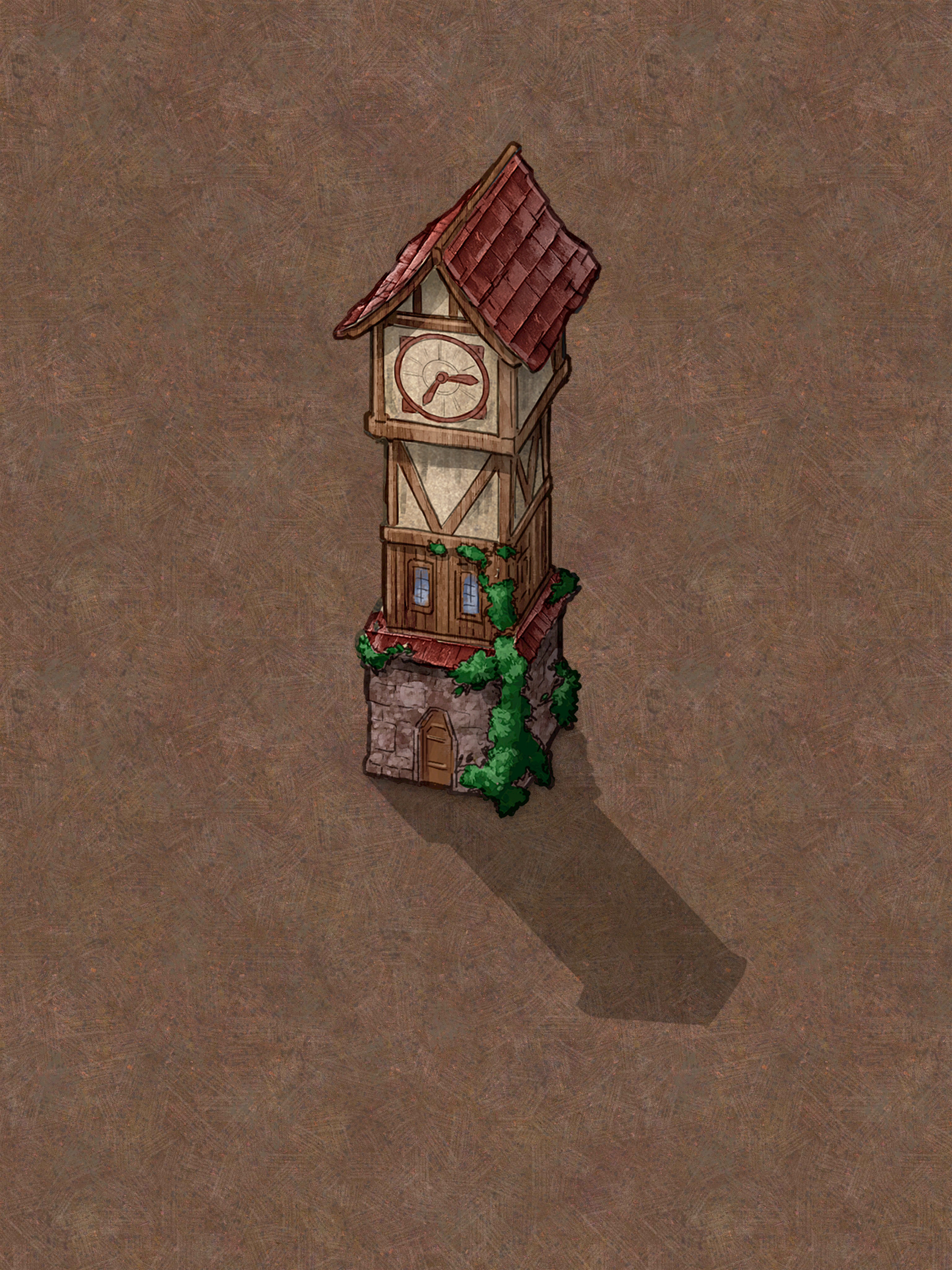
    Cragbend clock tower

    A large stone clock tower outlined with dark wood in Tudor-esque style marked the center of town. It was one of the few stone items I had seen so far here. The smooth facade gleamed cream with pink streaks in the bright sun. A large, triangular shaped crystal of the same bronze stone as in my pocket clock glinted in the clock face, pointing just after the eleven. It still felt like the days were the same length as home, it was so hard to tell when my frame of reference was gone.

    There was something remarkable about the sun here. The light it gave off was of an intensity that made me expect it to be unbearably hot, but it wasn’t. It felt like a June summer day in New England, no humidity, perhaps around 80 degrees. Was that the weather workers’ doing? How much did they have control of? Did they plan a week’s weather (um, an anek’s weather, I should say) like a menu? When did it rain? It must be frequently, with the lushness of the land and the healthy haystacks I noticed. I had never felt so unknowledgeable before.

    So many questions I had, can’t you imagine? No, I didn’t have an escort or anything, I didn’t need one. No one mentioned any threats or things to watch out for. Kind of telling that’s what we think of first, right? Come to think of it, I hadn’t even seen any guards in Rosewood Manor. I guess with a living house that could help when it was needed, people defenders were unnecessary. I’d hate to think what that house could do to an intruder.

    The field next to The Cleft Barrel stood empty, the Bluebirds had moved on to their next stop. I felt a pang of sadness at that, but it was replaced by the hope that I would see them again someday. Maybe the other Madrigal troupes too, so I could compare all of their shows. Perhaps a festival. Surely a society with such amazing performers would hold festivals, right?

    Since I knew the road to the right headed back to Venrood Forest, I took the left fork. One of those many pointed signs indicated that somewhere down the road were places called Sagebridge, Arrowbreak, and Crescenton. I wondered what they were like. Were they family seats, too? I could hear the rhythmic splashing of a water wheel not far away, and maybe the grinding of millstones? The scents of cooling bread enticed me as I passed a bakery, no wonder as plump baguettes filled racks just inside the windows. Even the carved sign of a steaming loaf above the door looked good enough to eat!

    Photo by form PxHere

    Just then the door of the bakery flew open and three boys scampered out, a stout baker hot on their tails. As the boys rounded the corner toward me and the road, the one in front, a black-haired boy in green shirt and gray knee breeches, reached in the window and snagged two of the baguettes. They took off down the street in the direction I was headed, hooting and laughing. The baker’s rolling pin clocked the slowest boy in the back of the shoulder, but he did not slow.

    Photo by form PxHere

    Wow! That was a surprise! And there I was, caught in the middle! We’ll find out next time what happened 😉.~


    And there it was, the first bit of mischief or dissent that I had witnessed since arriving. I did feel bad for the baker, but it was a great throw of the rolling pin! The money, though, I wasn’t sure what to make of that, it was so different. I’ll tell you what I learned about it next time. What would you do in a new town in a new world for several hours? Drop a comment in the box below and we can talk about it 🙂.

    In some other news, Quill & Orb Press, (the fiction part of my word services business), is ready to do developmental edits and copyediting for YOU! Fantasy, paranormal, YA, historical fiction, and other genres welcome.

    Are you an Indie author? I’d love to work with you!

    Click here for a list of genres I review, and other services I offer:

    Or click here to contact me directly:

    Want more info about life in Huphaea? Sign up for Collata ⚡, The Collection of Huphaea newsletter! Nightingales get some more inside bits about my time in Huphaea, and other news on my writing and related interests. Once a month, so no cluttered inboxes, just a snippet here and there. Join the Nightingales, Eleanorah’s troupe!

    ©2020 Eleanorah Starr and Quill and Orb Press. All Rights Reserved.

  • Reblog — Begin at the Beginning … or Maybe Not — Writer Unboxed

    It’s a question asked by writers every time they sit down with a new idea: “Where do I start?” It is also one of the most important decisions an author makes, as it can influence a reader enough to keep reading, or put the book down. This post contains some valuable tips to think about when you get down to the opening scene.~

    Flickr Creative Commons: Roan Fourie

    Lewis Carroll advises, through his creation the King of Hearts: “Begin at the beginning, and go on till you come to the end. Then stop.” The King of Hearts is speaking about telling a story aloud, to a listener. As novelists, we don’t always tell our story in chronological order, and…

    Begin at the Beginning … or Maybe Not — Writer Unboxed