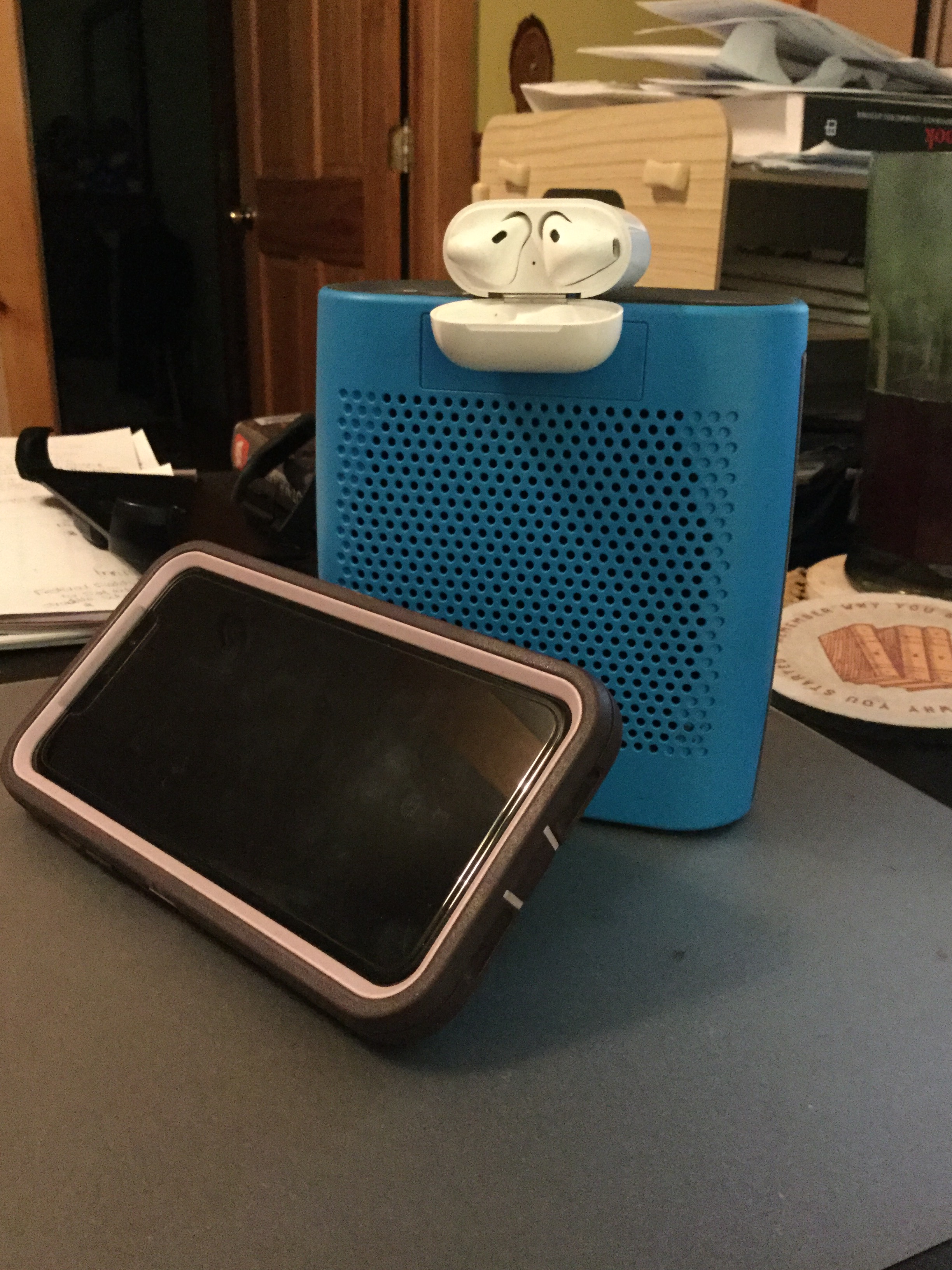

Ah, my three ubiquitous companions. These devices have the singular ability to be able to accompany me ANYWHERE, something my dogs cannot do but would if they could.
And they also take me anywhere in time and location. So while I may be head down weeding furiously around blooming perennials, my mind thinks I am in 1918 London solving mysteries alongside Maisie Dobbs, or inside the mind of Sherlock Holmes as ‘he’ is portrayed by Sherry Thomas in late-Victorian society. The power of story never fails to amaze me.
I have always loved reading aloud, I’ve done it for years to my dogs on hot afternoons or late evenings to settle us all down. The stories leap off the pages into the fore of my mind, becoming more real the more I speak. I’m not sure if that is the case for everyone, but I would almost be sad if it were not. I wasn’t sure if listening would provide the same experience for me and I am thrilled that it has. Hours weeding in the hot sun in messy gardens fly by, while the dogs’ walks become calmer too. I am able to fall into the story almost as if I were holding the book myself.
Recently, I began listening to the Maisie Dobbs series by Jacqueline Winspear. I was unsure about the time period, pre- and post-WWI London, but library availability was scarce, so I took the chance. When the book was done, I returned it and looked for the second in the series (I think there are fifteen so far) immediately.
The second book, however, changed narrators, and I was a bit crushed. Now I understood about readers following narrators.
The first narrator undertook the tale in a pleasant, hopeful voice easily associated with a younger female. The male parts she infused with a warm and caring tone befitting of Maisie’s father and mentor. I was attentive to the dialogue especially, learning for future reference.
The second book, Birds of a Feather, features a crisp, more sophisticated and controlled narrator that took several chapters to get used to. I actually considered stopping listening because I was so unsettled. However, I continued, as I was well into the story by then, and I’m glad I did.
By the end, I thought it actually a brilliant decision on the producer’s part to change narrators (if that was the case), for Maisie’s character had undergone many changes as well, thanks to the war duty she saw. The Maisie who emerged from medical duty in France was harder, leaner, and inquisitive in a more pointed way than before. The new narrator had nailed this sentiment, I felt, with her clipped speech patterns and deeper tones.
And yes, I do have the third book on hold to listen to when it becomes available 🙂. From looking ahead though, I will hear a third narrator and I hope she is as insightful as the other two have been.
I’ve picked up many pointers just listening to the different narrators in my short time consuming audio stories. All food for thought as I continue to practice reading and differentiating characters to my dogs on these lazy summer days. I’m priming for the best performances I can give!~
Do you evaluate the narrators of the audiobooks you listen to? What things do you notice and what will make you stop listening? I’d love to know while I’m learning this craft, leave me a comment below!